The Room Is the Controller: Danielle Brathwaite-Shirley on Designing Games for Galleries
Most artists working in games start online and stay there. Danielle Brathwaite-Shirley started with a live audience in the room and has been designing around that fact ever since.
She came to art from theoretical physics, arrived at the Slade thinking art meant painting and sculpture, and spent her early years making animated films of games that didn't exist: fake pitch reels, ten minutes long, complete with a fake cursor making fake choices. The first real game came in 2019: a choose-your-own-adventure built from footage shot with a group of Black trans collaborators in London, released online and installed in a space at the same time. That double life has defined the practice since.
We talked about what actually transfers when a game leaves the screen and enters a gallery: the exhibition design process behind THE DELUSION, her multiplayer commission at Serpentine North, why she studies arcade cabinets before every show, the operational gulf between single-player and multiplayer work inside an institution, and why she now designs deliberately for the visitor who walks in and thinks: absolutely not.

Jamin: What was the moment a linear medium stopped being enough?
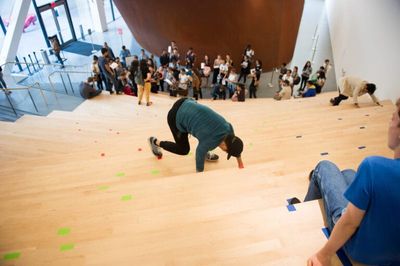
Danielle: I'd made a forty-minute animated film, a fake game essentially, and I performed alongside it. The engagement when I performed was a hundred times what it was when people just sat and watched. People would cry. There's a lot in the work about death, and when someone has to carry that themselves, it stops being about whether the work was good or bad. It becomes embodied.
So I thought: I changed everything in that room by making one choice. What if they made the choice, and it changed everything for everyone else? Where does the art live then? Is it the thing I made, or the series of choices everyone made, or the regret of the wrong decision when you've messed everyone up? But I can't perform twenty-four hours a day. Games were the natural evolution. If you watch the animations, I was already making a game with everything but the choices.
Jamin: Was there ever a purely online phase?
Danielle: No. The first game was a collaboration, and it went online and existed as an installation at the same time. Even when I made online work later, I was thinking: they're sitting at home; how do I keep them there? Easy tricks. Get their name and use it back at them. Get their age and use it later. Lock them out of choices because they picked something earlier. Make it feel like theirs, make them responsible, make them regret things. I'll decide I want to lock someone out before I know why, then work out why. I think in the emotional state I want to put you in before I know the content.
Jamin: What's your guidance for someone moving work from a screen at home into an installation?
Danielle: Lock them in the moment they step in the room, before they've touched the controller. The controller should beckon them over. Being in the game should be an extension of the experience, not the entire experience.
In a gallery, people arrive prepared to consume, not to interact. So you have to prepare them. When we install, we make the same flowcharts we'd make for the game, but for the room. If someone walks here, what happens? If they look at that wall, what do they feel? I want them scared before they play. How do we do that? Can they hear the soundtrack before they get in?
For She Keeps Me Damn Alive, you could see a gun through a curtain, and a video making you desperate to pick it up. You'd go in, pick it up, shoot at the screen, and characters would appear saying "Don't shoot." Shoot again, and you'd fail instantly. Then it would talk to you about gun violence and ask you to shoot to protect people, without telling you who.
That's also why I'm a big fan of custom controllers. If I see a standard controller in a gallery with dead buttons, I get frustrated, and I play games every day. The gallery demographic is always wider than the playing demographic. You have to design for the person who looks at the controller and says, "I don't play games." The best outcome is someone leaves without realizing they played a game, and they've been there two hours.
Jamin: You look at arcade machines for this.
Danielle: Every exhibition. That whole generation was built on: get your attention, then you have to spend money on me. We also do an exercise where we judge a traditional artwork, then try to judge a game the same way: playing Might and Magic and going, okay, criticize this like the painting. It's genuinely hard. Which is the point. It reminds you these are artworks and we're just not programmed to read them that way.
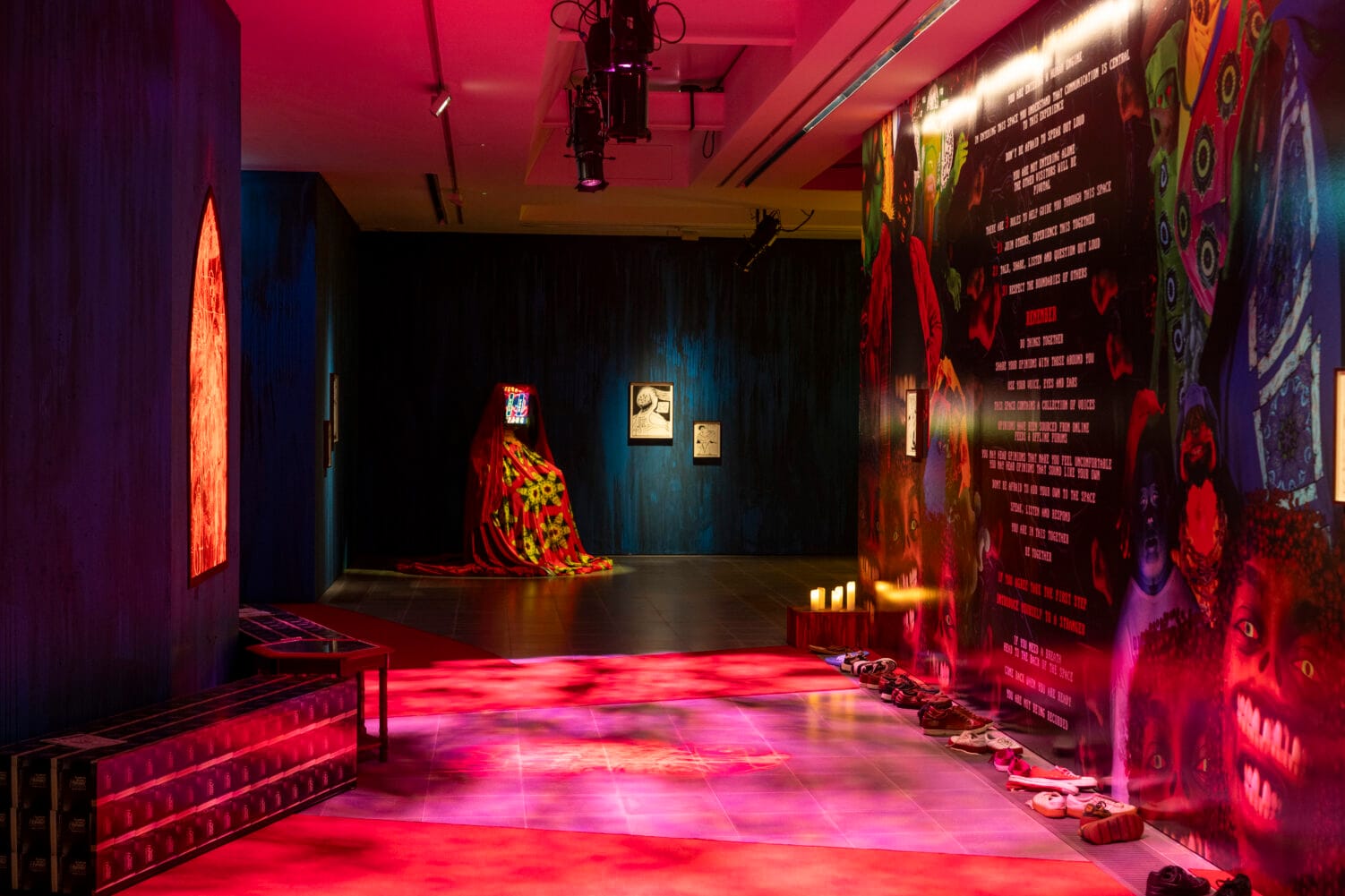
Jamin: Walk me through THE DELUSION at Serpentine North. It's modelled on your grandmother's house.
Danielle: We started somewhere else, trying to mimic online analog horror, backrooms, that kind of domestic creepiness. The goal was to get people talking to each other, to use a game to mediate conversation. We spoke to psychologists first, and they said: you need something familiar, and an activity people can do together, before you can ask the hard question. Familiarity plus shared effort builds enough trust that people feel safe.
We designed a backrooms space, did a full 3D render, and didn't feel connected to it. My grandmother had just passed, and my mum was selling her house, so it was on my mind—a place where I couldn't really have conversations. I wanted to rebuild it as somewhere you could. We worked with Lydia Chan on the redesign. In parallel, we ran a week-long game jam in a house in the UK with writers and coders, and that generated the lore: why the house is there, why the games happen indoors, and why they happen inside picture frames. Then back to Lydia for another render. Not a linear process, and not easy.
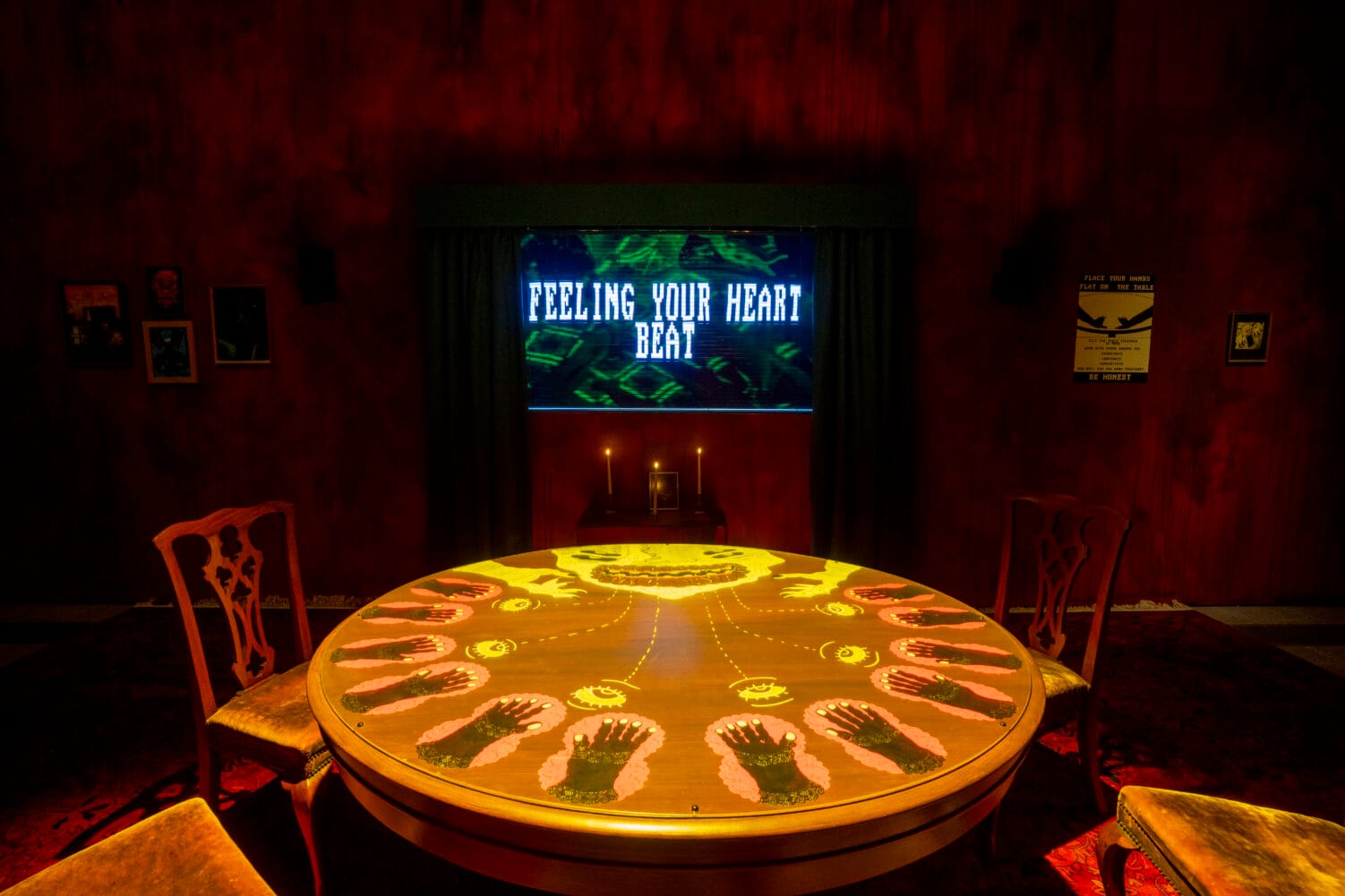
Jamin: Single-player versus multiplayer inside an institution. How different is that?
Danielle: Enormously. In single-player, I can send one person down a rabbit hole with a specific aim. It's also far easier to explain to an institution. One person plays, everyone watches, big screen, big sound, maybe fog. That's close enough to a film or a painting that they get it.
Multiplayer, someone joins twenty minutes in. How do they enter? How many ins do you have? Cutscenes are great for that. The work becomes less specific, because the focus shifts to what people are doing together, and honestly that's what everyone finds most exciting anyway. Then health and safety arrives. When you say there's no focal point, anything can happen at any time, and the controllers are life-sized doors and tables; people get worried fast. It's a performance that requires the room to get on with each other. So onboarding is everything: telling people it's playable, how long it takes, that this is a controller, three times over. One person understanding isn't enough.
Jamin: What have you learned about what institutions can say yes to?
Danielle: It's less about what they can say yes to and more about how well you pitch something they're already excited about. Serpentine wanted something transformative, tied to the performance work they'd seen me do, so I knew I could push the format, break the rules, have people hate it, and they'd be on board. That's a real risk for an institution with a lot of sponsors, especially when political conversation is being shut down. LAS is a paid show, so it needs to feel like a showstopper: cinematic, immersive, worth the ticket. Same medium, completely different risk.
The other thing is audience. Institutions want their existing audience happy and a new one brought in. That's a normal question if you're pitching a game commercially, but it's not in the room when you're mid-build in the studio. I've made it part of the process early, so we're not reconstructing half the work later.
Jamin: And the people who won't accept it as art?
Danielle: Some people are going to hate it. That's great. Design for it. Hate is a strong emotion to leave a show with: you want loved it, hated it, made me cry, made me feel wonder. You don't want "it was okay." When I finished The Last of Us Part II, I didn't think what a fun game, I thought I'm never touching that again. But that's the memory. That's what institutions can do with games that products can't: take enough risk to leave an imprint. It's much harder to take that risk when you need to make money.
And it isn't only older patrons. Plenty of them are genuinely excited about the tech. It's a subset of people at every age. The fun challenge is finding the hook for the one who walks in, sees something interactive, and goes: God, no.
This interview is edited for content, grammar, and style.
No spam, no sharing to third party. Only you and me.